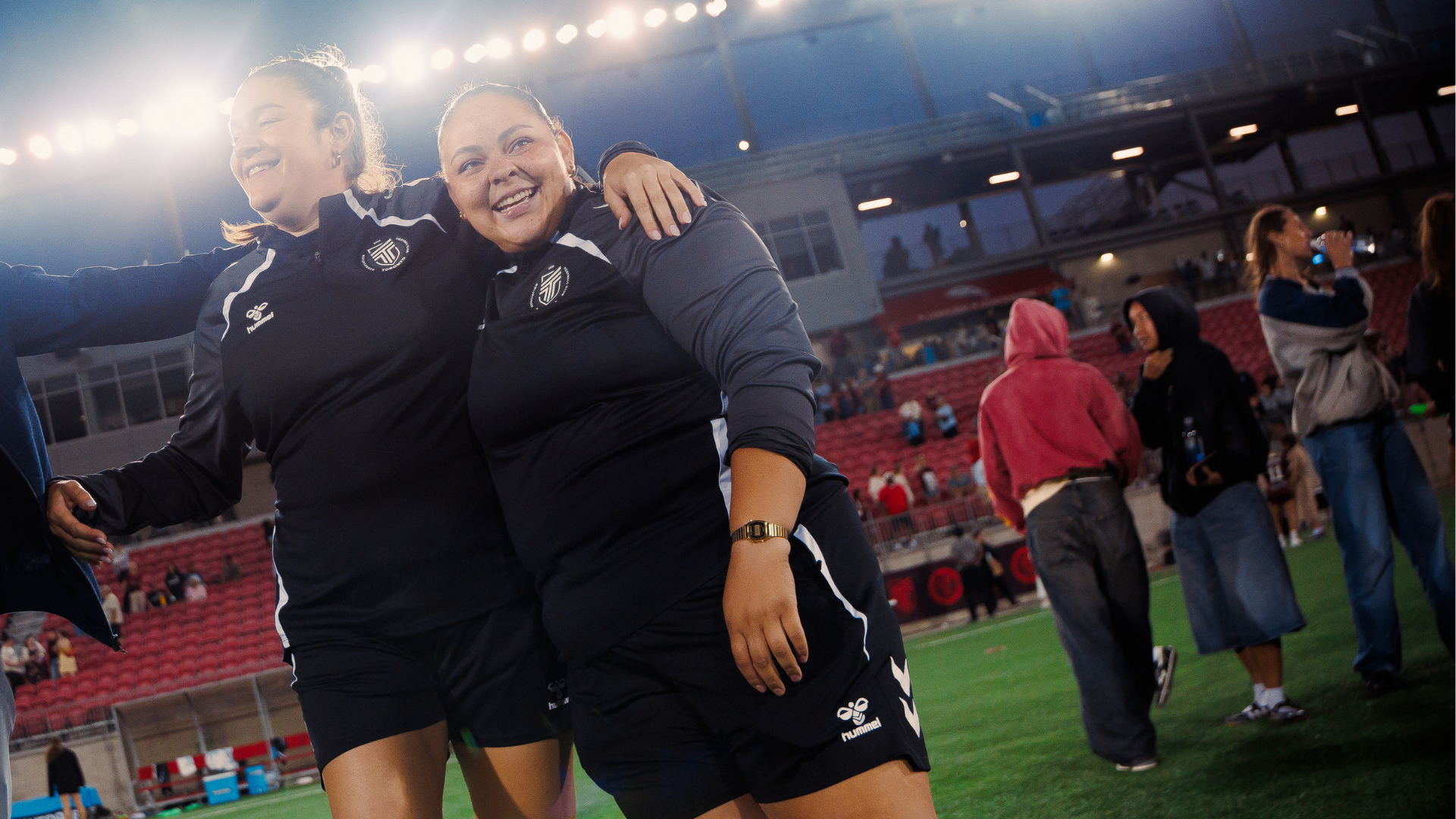
Meet the women helping prepare AFC Toronto to compete, perform and grow, long before matchday begins.
When the whistle blows on matchday, supporters see the final product. What they don't see are the countless hours of preparation that happen long before kickoff.
Behind every training session, match plan and performance on the pitch is a team of women helping AFC Toronto compete at the highest level. Whether they're developing players, preparing training sessions or ensuring athletes are physically ready to perform, the club's technical staff play an essential role in building a winning culture.
As part of She Leads the Game, we're shining a spotlight on two of the women helping shape AFC Toronto from the sidelines—alongside the many others working behind the scenes, including Karla Leong (Lead Athletic Therapist), Kia Halsall (Athletic Therapist), Onika Green (Mental Performance Coach), Keyosha Donkor (Equipment Manager), Aimee Maiatico (Player Care and Club Operations Manager), and Negar Najarnejad (Team Manager).
Sylvia Forbes | Assistant Coach
For Sylvia Forbes, coaching started with a desire to stay connected to the game. It became something much bigger.
Having played at Purdue University and represented Canada internationally at the youth level, Forbes experienced firsthand the influence a coach can have on a player's development, confidence and belief in themselves. Those experiences eventually changed the way she thought about her own future in the game.
"I began to see coaching as so much more than a role on the sideline. It was an opportunity to shape experiences, build confidence, and have a meaningful impact on the players I coached."
As she began coaching after her playing career, Forbes discovered that watching a player develop and succeed on and off the field could be just as rewarding as her own accomplishments as an athlete. Today, as Assistant Coach at AFC Toronto, Forbes works alongside the players and coaching staff to prepare for every training session and match. But for her, coaching is ultimately about the relationships behind the football. She describes her approach as caring, demanding, honest and supportive. She holds players to high standards and expects them to take accountability for their development, while creating an environment where they can ask questions, make mistakes and challenge themselves.
"I want to take the time to get to know my players as people, not just as athletes, and create an environment where they feel comfortable being themselves, asking questions, making mistakes, and challenging themselves."
Forbes also believes players should understand the why behind what they're being asked to do.
"I want my players to understand why we are asking them to do something, rather than simply telling them what to do."
That philosophy extends to how she thinks about the role of coaching itself. Football should be challenging, she says, but it should also be fun. The goal is to create a culture where players trust their coaches, trust one another and know they will be pushed to become better while always having someone in their corner. Forbes says some of the most rewarding moments come in the small signs of progress: when something worked on in training appears in a match, when a player begins to believe in an aspect of their game they once doubted, or when their confidence begins to grow.
"For me, coaching is about the relationships you build and being able to support players through their journey. Being able to see them enjoy the game, challenge themselves, and become more confident in who they are is what makes it so rewarding."
That commitment to people is also at the heart of how Forbes thinks about representation. As a young player, she remembers looking up to coaches and other figures in the game and the impact they had on her. Now, she recognizes the significance of being that person for the next generation.
"Young girls need to see women in different roles within the game and know that there is a place for them, whether that is as a player, coach, technical director, analyst, or in another role. I want them to understand that they don't have to limit what they can achieve or what their future in soccer can look like."
Forbes hopes that simply seeing her on the sidelines can help a young girl recognize coaching as a possible future for herself.
"If I can help even one young girl believe that she belongs in this game and that a career in coaching is possible for her, then that is something I would be very proud of."
Her advice to that next generation is simple: start.
"Don't wait until you feel completely ready or until someone gives you permission to pursue it. Get on the field, coach, ask questions, watch games, learn from other coaches, and continually challenge yourself to get better."
And when the path gets difficult, Forbes says, don't let those moments define you.
"Let your preparation, your knowledge, your relationships, and the way you treat people speak for you."
Mariana "Maddie" Gonzalez Moreno | Sport Scientist & Performance Coach
For Maddie, performance is built long before matchday.
Her interest in sport science began with a simple question: why do athletes perform the way they do?
"I think I really started to become curious about sport science and performance when I started to become curious about the why behind performance."
That curiosity led Gonzalez Moreno to study Exercise Science, complete her Master's in Kinesiology and earn her CSCS certification. But it was working across different high-performance environments, including Toronto FC, Canada Soccer and the Canadian Sport Institute Ontario, that brought the science to life.
"I loved being able to take data and research and actually apply it to athletes in front of me."
At AFC Toronto, that curiosity has translated into the opportunity to build something from the ground up. As Sport Scientist and Performance Coach, Gonzalez Moreno leads the club's performance monitoring, strength and conditioning and sport science programs. But she sees the work as much more than collecting data or running gym sessions.
"It's about creating a system where the information we collect helps us make better decisions."
Building AFC Toronto's performance program from scratch has meant asking what actually matters to the players, coaching staff and the club's style of play. Over time, ideas around training monitoring, positional individualization and communication with coaches and players have become part of the team's everyday environment. For Gonzalez Moreno, the most rewarding part has been seeing that trust grow.
"When players understand why we're doing something and coaches are using the information to help make decisions, that's when you know the performance program is actually having an impact."
Her work also reflects a broader evolution taking place across women's professional sport. Gonzalez Moreno has seen more opportunities open for women in sport science, strength and conditioning, sports medicine, coaching and leadership. But she believes the next step is about more than simply getting women into the room.
"It's not only about creating opportunities for women to enter these environments. It's about giving women opportunities to lead, make decisions and help shape what high performance looks like."
She also sees a need for greater investment in research and resources dedicated specifically to women's high-performance sport.
"Working in professional women's football has been particularly meaningful because we're building the women's game while also building the systems around these athletes."
For the next generation of women interested in high-performance sport, Gonzalez Moreno has one piece of advice: stay curious.
"Sport science is such a broad field that you're never going to know everything, and that's actually one of the things I love about it."
She encourages young women to ask questions, find mentors and seek out hands-on experience, while recognizing that technical knowledge is only part of the job.
"You can understand all of the physiology, data and research in the world, but ultimately you need to be able to turn that information into something meaningful for a player, coach or key stakeholders."
And then there is the confidence to use that knowledge.
"There will probably be moments when you're the youngest person in the room, the only woman in the room, or you're questioning whether you have enough experience to speak up. Your perspective still has value."
For Gonzalez Moreno, that is part of what it means to lead in high-performance sport: continuing to learn, staying open to being challenged and having the confidence to take up space in the environments you've worked hard to be in.
"Back yourself. Keep learning, stay open to being challenged, and don't be afraid to take up space in the environments you've worked hard to be in."
Leadership Beyond the Touchline
For Sylvia, Maddie and the women working alongside them, leadership is rarely about having the spotlight. It's about showing up every day, sharing expertise, building trust and creating an environment where others can succeed.
Their roles may be different, but their impact is connected. They are helping develop players, strengthen performance, build confidence and create opportunities for women within the game.
And as professional women's soccer continues to grow, so does the importance of the women helping shape what comes next.
As AFC Toronto celebrates She Leads the Game, we recognize the women who are helping build that future, one training session, one player and one match at a time.